
By Legacium Editorial Team
Every Photo Tells a Story You Haven't Written Yet
That shoebox in the closet, those albums on the shelf. They're not just keepsakes. They're chapters of a memoir waiting to be told.
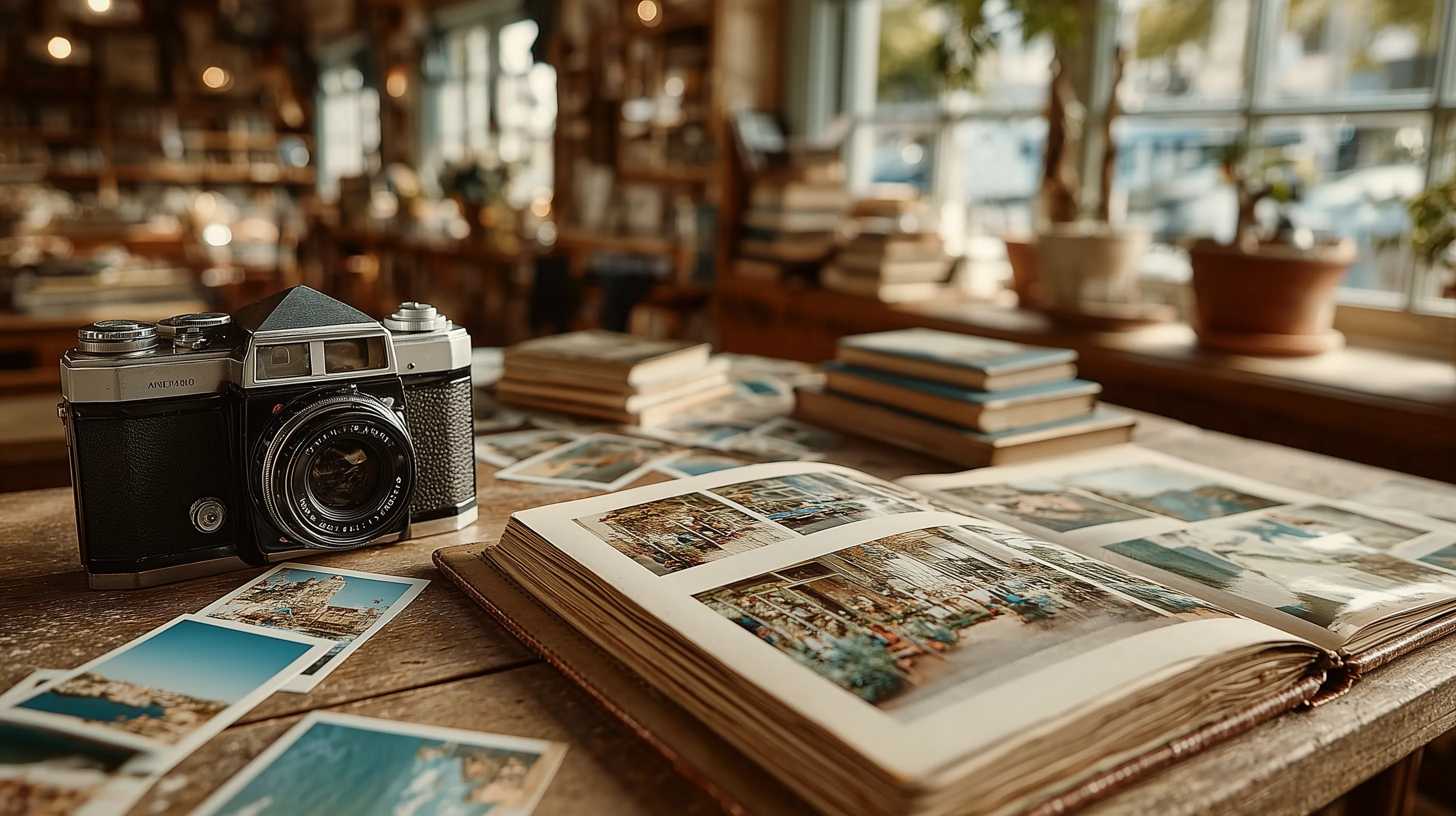
You are holding a photograph you have not looked at in twenty years. It is creased at one corner and slightly overexposed. In it, your mother is standing in a kitchen that no longer exists, wearing an apron you had completely forgotten about, laughing at something just outside the frame. You do not remember the day this was taken. You do not remember who held the camera. But something about the light in that kitchen, the angle of her shoulders, the way her hand rests on the counter. Something about all of it opens a door in your memory you did not know was there.
Suddenly you remember the smell of that kitchen. The way the radio played low in the afternoons. The feeling of sitting at that table doing homework while she cooked. You remember a conversation you had there once, years later, about something that mattered deeply to both of you. None of this was in the photograph. All of it was behind it.
Why do photographs unlock memories that words cannot?
Photographs bypass the analytical brain and activate visual, emotional, and sensory memory networks simultaneously, which is why they do not ask you to think about your past but put you back inside it. According to psychologist Allan Paivio's dual-coding theory, memories encoded with both visual and verbal information are recalled significantly more effectively than those encoded through words alone, because the brain creates two independent but linked memory traces. This is why a written prompt, “Tell me about your childhood home,” activates the verbal and analytical regions of the brain, while a photograph activates the visual cortex, the emotional centers, and the sensory memory networks all at once.
Researchers studying autobiographical memory have found that images serve as what they call “retrieval cues,” sensory anchors that pull associated memories to the surface in clusters. Studies on photo-elicitation, a technique used in qualitative research where participants discuss personal photographs during interviews, have shown that viewing personal images produces richer, more detailed, and more emotionally authentic recall than verbal prompts alone. A single photograph does not return a single memory. It returns an entire web of connected experiences: the sounds, the textures, the emotions, the people who were just out of frame. This is why looking through old photos so often produces the feeling of being flooded. You expected to see a picture and instead you recovered an entire period of your life.
A photograph does not return a single memory. It returns an entire web of connected experiences: sounds, textures, emotions, and people just out of frame.
What stories live between the photos?
The most important thing about a photograph is never what it shows. It is what it does not show. The moment before. The moment after. The reason someone picked up a camera in the first place. The person behind the lens who thought, even if only for a fraction of a second: this matters. I want to keep this.
When you look at a family portrait taken at Thanksgiving in 1994, the image shows twelve people arranged on a porch. What it does not show is that your uncle had driven six hours to be there because he knew it might be your grandmother's last holiday. It does not show that your cousin had just announced she was pregnant. It does not show that the person who took the photo, your father, had quietly stepped out of the frame so everyone else could be in it.
These are the real stories. They live in the margins of the image, in the white space around the frame, in the memories of the people who were there. And unless someone tells them, they disappear. The photograph survives. The story behind it does not.
Why do your own photos matter more than any stock image?
There is a difference between a photograph in a book and a photograph in your book. Stock images and illustrations can be beautiful, but they carry no memory. They hold no charge. They do not stop a reader, your daughter, your grandchild, someone who loves you, and make them say: I remember this. I was there. I know that kitchen.
The photographs that belong in a memoir are the ones that belong to you. The slightly blurry shot from a birthday party. The formal portrait where nobody is looking at the camera. The snapshot of a house you lived in for three years and left without looking back. These images are not beautiful in the way a magazine photograph is beautiful. They are beautiful in the way truth is beautiful: specific, imperfect, irreplaceable.
This is why a memoir built around your own photographs becomes something more than a book. It becomes an artifact. A family heirloom that carries not just your words but the visual evidence of the life you lived: the faces, the places, the light of particular afternoons that will never come again.
How do you choose the right photographs for a memoir?
Not every photograph needs to be in your memoir. The most powerful ones are not necessarily the most polished or the most dramatic. They are the ones that make you feel something, the ones that stop you mid-flip and pull you back into a moment you had forgotten you remembered.
Look for images that raise questions. A photograph of your parents before you were born: who were they then? A picture of a house you barely remember living in: what happened there? A snapshot from a trip that changed the way you saw the world: what were you running from, or toward?
Look for the candid shots over the posed ones. The moments caught in between: the laugh that was not meant for the camera, the look exchanged across a room, the child asleep in the back seat after a long drive. These are the images that carry narrative weight, because they capture life as it was actually lived, not as it was arranged for display.
And do not worry about gaps. A memoir does not need a photograph for every chapter. Sometimes the absence of an image is the story: the years you did not document, the places where no camera was present, the period of your life when you were too busy living to stop and take a picture. The words fill in what the photos leave out. That is the partnership.
What if a photograph is really an invitation?
A photograph is not a finished story; it is an invitation to tell one, because the image captures only the visible surface while the context, the emotion, and the meaning live in the person who was there. Every photograph you have ever taken or kept is a small act of faith, a belief that this moment was worth preserving, that someone, someday, would want to see it again. But a photograph on its own is only half the story. It is an image without context, a face without a voice, a place without a reason.
The other half, the context, the voice, the reason, lives in you. It lives in the memories that the image triggers, in the stories you could tell if someone asked the right questions, in the details that no camera could ever capture. A photograph is not a finished story. It is an invitation to tell one.
The question is whether you accept the invitation. Whether you sit with the image long enough to let the memory surface, and then find the words to give it life. Not someday. Not when the time is right. Now, while the stories are still yours to tell.
Legacium
Your photos hold stories only you can tell.
Legacium helps you weave your personal photographs into a beautifully written memoir, capturing the stories behind the images before they fade. Upload your photos, share your memories, and receive a hardcover book your family will treasure.
Learn how it works